

If you have previous experience of ILI crack detection campaigns, you may have already experienced some of the primary challenges associated with interpreting and responding to the results. Responding to the features that actually pose an integrity threat from within the population of reported ‘crack-like’ anomalies, can cause operators a huge headache and a lot of unnecessary expenditure. The ILI vendor may report features with crack-like signal characteristics that pose a negligible threat to pipeline integrity, such as sharp-edged corrosion, weld cap shape irregularity or manufacturing laps.
An example of a typical situation is described below:
- A Crack Detection tool is run for the first time to detect crack-like anomalies.
- A call is received from the ILI vendor: “We see something in your data that meets the immediate call criteria!”
- What should you do?
Shut down?
Continue operation and plan verification?
Ignore and wait for your final report?

Some operators would take the decision to make immediate changes to their operation (reduce pressure or shut in) until the call was validated, given the recommendations from the ILI provider. Although a conservative approach, this can result in significant wasted time, cost and effort. These effects can be compounded if you discover that the anomaly was in an area where the cracking susceptibility is known to be historically low, and the same feature was also reported in a previous metal loss ILI run but this information was not considered when deciding on the response.
Added to this, the critical dimensions of a true crack will vary significantly from pipeline to pipeline and will even change within the pipeline itself depending on material properties, stress state and crack growth mechanism. Other risk-related factors such as the consequence of failure should also be considered.
It is clear that trying to make integrity management decisions solely based on the reported ILI results carries significant associated uncertainty and therefore risk.
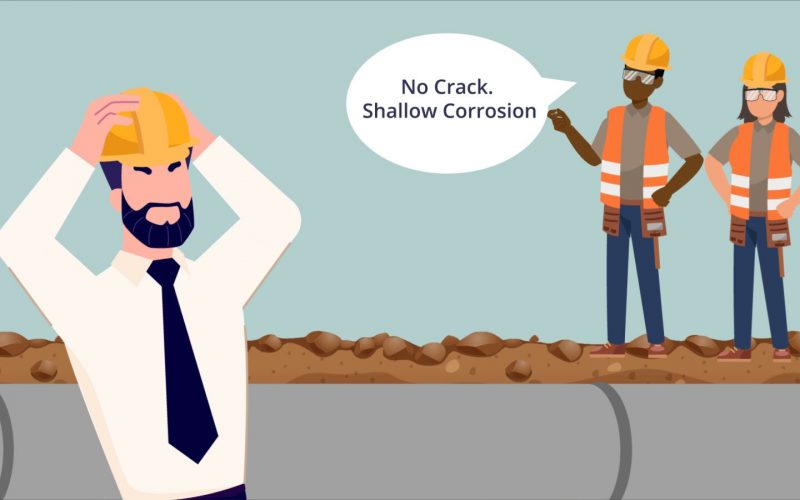
Once operational changes are implemented and verification is underway, operators are hoping for a good find for a number of reasons:
- To review cracking threat and confirm pipeline integrity.
- To review tool performance.
- To prove to the operational team and management that the expense and inconvenience was justified.
Being suitably prepared upfront to integrate the crack-detection dataset with other existing threat-related information to expedite integrity management decision-making when the ILI results begin to land is a key theme within current industry best practice for crack management (API RP 1176).
Below are some top tips from Frontline Integrity to get yourself prepared for the crack detection ILI results:
- Evaluate the credible critical flaw size and leak-rupture boundary of your pipeline ahead of any inspection, noting that this will vary along the pipeline with stress level and material population changes. Also consider any pre- established ILI performance uncertainties - for example under sizing of complex SCC colonies warranting a response at lower reported depths.
- Integrate this information with your cracking susceptibility and consequence model (i.e. risk profile).
- Plot the distributions of any existing ILI anomaly data (not necessarily cracks) in preparation to overlay the ‘new’ crack detection dataset.
- Develop a suitable risk-driven anomaly response criterion along the pipeline. When do we need to dig? When can we remediate? When do we have to repair? Ideally this should have also been integrated into discussions with the ILI vendor before the inspection, to align with ILI reporting thresholds and ‘immediate’ call criteria.
- Do we have appropriate safeguarding procedures in place to keep personnel safe in an excavation where a near-critical feature exists?
- Do we have appropriate people, processes and equipment available for repair and remediation if required?

How can we help Operators and what value do the Frontline Integrity team add?
Frontline Support Services
Added Value
Develop, review /audit credible critical crack sizes. Define and manage the process of refining critical crack sizes through targeted collection information on materials, stress state and data.
Supports customers to determine suitable response criteria and avoid under or over conservatism.
Develop susceptibility and risk profiles and integration of critical crack sizes.
Allows customers to identify locations which need prioritising for data evaluation and / or treating with increased caution in terms of an appropriate response criteria.
Support the development of an appropriate response criteria.
Helps customers to anticipate all credible ILI scenarios (feature type, location and size – depth and length) and develop a suitably risk-driven response plan for reported anomalies.
Audit, system selection and specification of code-compliant repair and remediation solutions. Development of repair and remediation procedures.
Ensure preparedness to mobilise if repairs or remediations are required.
Get in touch today 😊


