

To maximise the value of any ILI campaign, the quality of data is of course important, but equally as critical is knowing how to interpret the results to ensure balanced, yet safe, integrity management decision making. This is particularly important for crack detection ILI, where the true integrity threats can be challenging to extract from the reported overall population of ‘crack-like’ anomalies. Using all available threat-related data to support the interpretation of the ILI results is also a central theme in the current industry best practice for crack management, API 1176.
One aspect that is commonly overlooked by ILI vendors, is the value of integrating historical data into the evaluation process. This could be in the form of previous ILI signal data (from multiple technologies), verification points, repair records, previous failures or even the operators current risk profile for a particular threat.
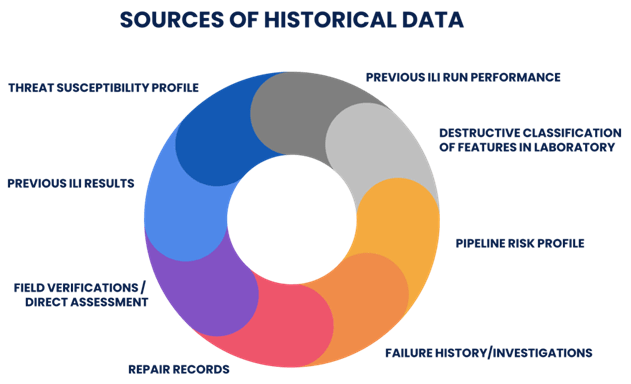
Incorporation of historical data into the current ILI campaign will ultimately improve the overall output. Context is provided, by focusing both the Pipeline Operator and the ILI vendor on key threat locations in the pipeline and how integrity threats may have propagated within it, giving the ability to scrutinise the credibility of anomalies found.
At Frontline Integrity, Pipeline Operators place us into an ILI project to ensure that the pipeline history is not lost. We take the time to understand the Customer’s specific integrity management concerns and get up to speed quickly on the asset, working closely with the ILI vendor during the entire evaluation process to ensure no stone is left unturned. Examples of the data we typically integrate into a project are listed below:
- Historical field verification data – to support not only the understanding of the integrity threat but also provide an understanding of historical tool performance where the same uncertainties may also exist in the current run. Using relevant historical ILI tool performance to support the understanding of a future run performance is also a key part of the ILI verification process contained in API 1163 (ensuring an ILI system has been selected, prepared and run in a manner that is capable of achieving the stated vendor performance specification).
- Repair records - to ensure there is no attempt to address features that have already been remediated (e.g. recoating to arrest SCC growth)
- Previous ILI data (data quality, reported features / signals) – to provide consistency with the current dataset and review for evidence of change. To understand where repeat areas of data degradation may have occurred and assess their associated impact.
- Overall Risk, susceptibility or consequence profiles - to assist in the prioritisation of reported features.
Unfortunately, in our experience, the integration of the above is not standard practice and can lead to avoidable uncertainty in the integrity-management response.
Let’s look at an example and the questions that should be asked as we dive deeper to understand the situation at hand:
It has been reported that a corrosion feature is now 3 mm deeper than its reported depth in the ILI listing 3 years ago.

Every pipeline is different, but leveraging historic datasets can play a significant role in optimising the ILI campaign output, ultimately resulting in improved integrity-management decision making.
Why wait 6 months for a report and then ask if your previous data was integrated? Take action and get us involved at the evaluation stage.
How can we help Operators and what value do the Frontline Integrity team add?
Services Offered
Added Value
Review of all historical threat related information against ILI results to assist with interpretation and integrity management decision-making.
We always ensure all historical data is utilised to its maximum potential, meaning no stone is left unturned and maximising the value of the ILI dataset to the management of the threat.
Development of a data-integration strategy and management of ILI vendors to ensure all relevant integrity related data is integrated into an ILI campaign.
By developing an ILI data-integration strategy, you have the basis to make sure all future inspection campaigns are leveraging historical data to maximise run-value.
Interrogation of ILI signal data and data evaluation process.
Improves confidence in the output and consistency of the data evaluation process with respect to the integrity threat.
Threat propagation review.
Critical review of any evidence of anomaly growth in the pipeline from repeat ILI inspections and other supporting information.
Get in touch today 😊


