


Inspecting a pipeline with crack detection technology can be an expensive business and whilst the integrity team may feel the investment is justified, gaining approval from a management team can be difficult or sometimes impossible for a threat that is yet to be validated. Regrettably, the go-ahead for a crack detection inspection may only come after an in-service failure.
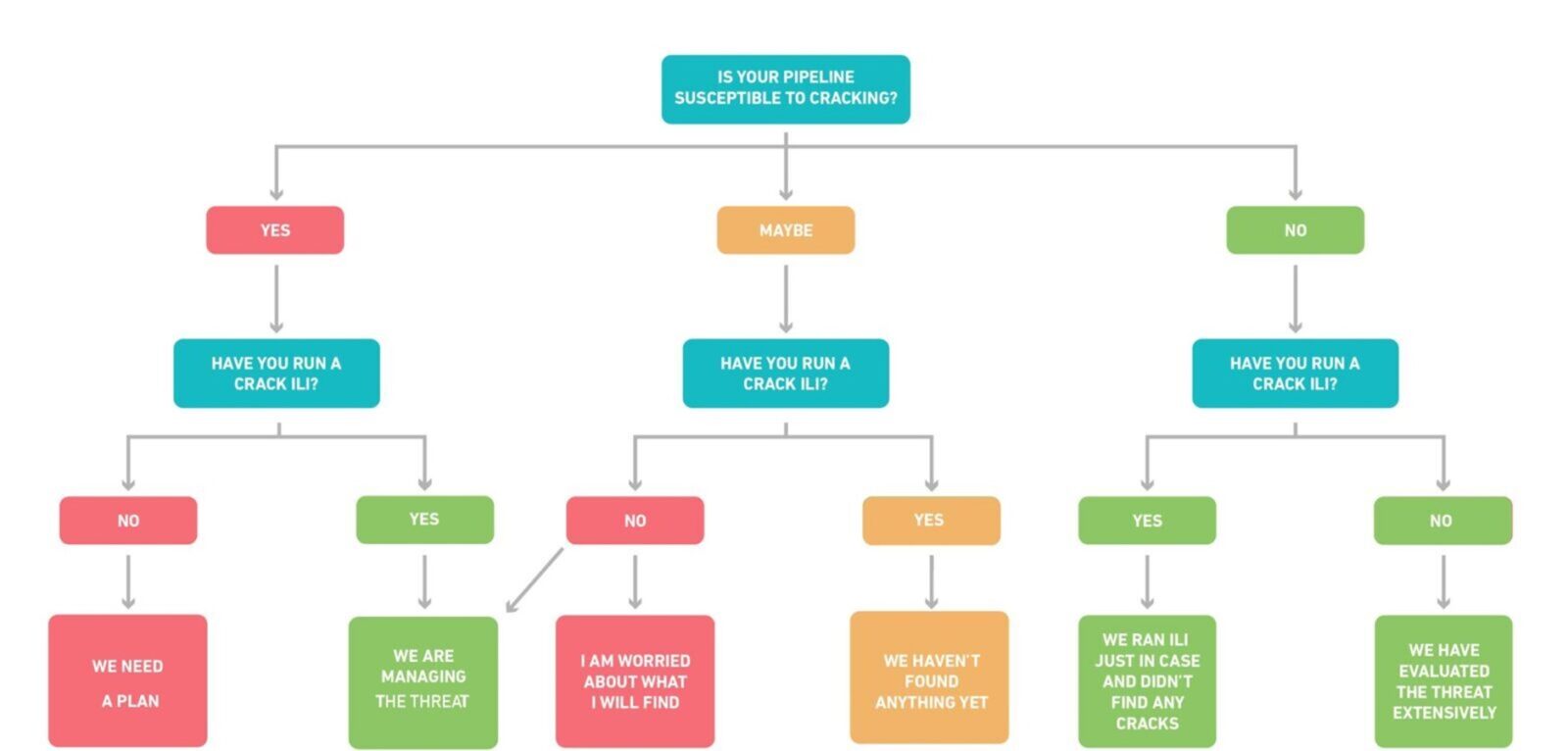
In our experience, when it comes to pipeline cracking, we usually see operators fall into a number of different categories each carrying varying associated degrees of risk.
Operators, which category do you fall within?
Some of the most common questions we receive from pipeline operators are:
- Are cracks credible on my pipeline system?
- Which pipeline should I inspect first?
- Are there any cheaper alternatives to crack detection?
- Do I really need to inspect with a crack detection ILI tool?
- I have run a crack detection inspection and I have found nothing. Is this the end?
- I have run a crack detection which has reported an unmanageable number of crack-like indications, what should I do?
It is therefore critical to determine which cracking threats are credible on the system considering: the range of pipeline material; the pipeline stress state; the internal/external environment and the operational regime. Integrating this information into a risk assessment, considering consequence of failure, will provide a robust justification as to whether further threat mitigation activities, such as ILI, are justified.
Additionally, when comparing more advanced ILI technologies, such as crack detection, to metal loss (MFL or UT), crack detection ILI comes with a far greater level of uncertainty surrounding how to interpret the results from an integrity management perspective:
Firstly, all crack detection ILI technologies (as with all crack detection NDE technologies) report ‘crack-like’ anomalies – that is 2D planar ‘reflections’ in the pipe that possess the signal characteristics of a crack but may not actually represent an integrity threat. A robust understanding of the threat-drivers and technology performance capabilities is therefore required to be able to extract the integrity threats from the overall population of reported crack-like anomalies.
Secondly, Crack detection ILI tool performance is hugely sensitive to a wide range of parameters:
- The inspection conditions - particularly flow velocity and presence of debris
- The size and shape (morphology), through-wall inclination and pipe-surface orientation of the crack.
- The crack location within the pipe and the pipe type itself (pipe body or seam weld)
- The presence of co-incident anomaly types (corrosion, dents etc) which can mask or distort the crack-like signal.
- The presence of additional geometric inhomogeneities co-incident with the cracking (e.g. weld misalignment).
An upfront, comprehensive understanding of the target threat and the tool performance capabilities with respect to the threat, is essential to evaluate how and where the ILI tool can support its management.
The criticality of a crack is very sensitive to the material properties (primarily fracture toughness) and the associated primary and secondary stress state at the anomaly location, which can vary significantly along a pipeline. Defining these parameters requires additional information to be collected, and attempting to make conservative lower-bound assumptions surrounding these parameters will generally result in an unmanageable number of assessment failures.
Detailed threat knowledge is therefore required to address all three of these points. Relating threat knowledge to ILI tool performance is also central to the verification process in API Standard 1163 which is associated with ensuring an ILI system has been selected, prepared and run in a manner that is capable of achieving the stated vendor performance specification. Additionally, it is also a key aspect of API RP 1176, the current best practice industry standard for crack management, in terms of appraising the extent to which the ILI can be relied on for integrity management decision making.
As with all pipeline risk-management activities, but particularly for cracking threats, ILI should therefore never be used as the standalone integrity management solution. A wide range of crack management tools are generally needed to support the interpretation of the ILI results and to form a balanced integrity management response. These include field Direct Assessment (DA), hydrotesting, critical defect analysis, metallurgical analysis, material property testing and burst testing. In some cases, ILI may not be required at all.
How do Frontline Integrity help Operators to maximise the value of a crack detection ILI and improve their overall integrity management response?
How can we help Operators and what value do the Frontline Integrity team add?
Services Offered
Added Value
System wide threat assessment:
- Perform cracking threat analysis (single or multiple cracking types) to identify key locations in the pipeline associated with escalated cracking threat.
- Audit of Threat Analysis (3rd party or customer)
We ensure all available data is integrated into any susceptibility assessment and the level of uncertainty is clearly identified; materials, current and future production profiles, as well as historic digs and repairs. As discussed, this is NOT a one size fits all approach but is developed to suit the pipeline and the specific threat-drivers that may exist.
Procedure to identify all of the steps required to evaluate the threat of cracking.
Independent and unbiased analysis:
- Not selling ILI tools
- Management strategy provides options to an operator, not a to do list.
Bespoke software assessment tools to screen networks for various cracking threats based on environmental, operational or known material susceptibility criteria.
Frontline Integrity have extensive experience supporting operators with similar issues globally to appraise newly-identified cracking threats as well as enhance existing crack-management programmes.
Get in touch today 😊


