Client: Gas Pipeline Operator
Project:
Axial SCC Risk Screening Procedure and Assessment
Overview
A natural gas transmission pipeline operator located in Asia Pacific engaged Frontline Integrity to support the enhancement of their approach to managing Stress Corrosion Cracking (SCC) threats across their extensive, multi-diameter pipeline network.
SCC had been confirmed on their network with other segments considered to be susceptible. The operator had developed an initial axial SCC threat screening process which Frontline Integrity was invited to review in order to gain greater alignment with recognised industry standards, including AS2885.6.
Following this review Frontline Integrity were further engaged to implement a series of targeted improvements, including:
- Risk-Based Prioritisation: Integrating consequence of failure into the screening methodology to transfer focus from threat presence to overall SCC risk.
- Enhanced Screening Resolution: Introducing a weighting system to improve the granularity of the screening results, enabling effective prioritisation of pipeline segments considered to require further assessment or action.
- Standards Alignment: Ensuring that recommended and required actions were consistent with relevant industry guidance and industry best practice.
- Tool Development: Creating a custom assessment tool to streamline the evaluation process and support dynamic response based on the results of mitigative measures.
Location
Asia Pacific

Challenges Faced by the Customer
- Network Size and Characteristics: With a complex pipeline system the operator had to implement an approach that was both consistent and applicable across the entire network.
- Uncertainty on Threat Level: SCC has been confirmed on some pipeline sections, with others identified as susceptible. However, gaining a clearer understanding of the risk level of each pipeline was essential to support the operator’s decision-making process around the SCC management and what / where to focus risk management efforts
The Approach
A risk-based screening process was developed to support the scheduling of targeted actions to further evaluate the risk of SCC on those pipelines in the network for which SCC was considered a credible threat.
The process was designed to be adaptable, allowing SCC risk management plans to be updated based on the findings of mitigation activities and new data insights.
Key benefits of the approach comprised:
- Cost Efficiency: Reducing unnecessary expenditure on risk controls that may not be required
- Comparative Risk Assessment: Enabling a direct comparison of axial SCC risk across pipelines, supporting informed budgeting and investment decisions while simultaneously effectively managing risk.
- Regulatory Compliance: Aligning with relevant industry standards and legislative requirements
Axial SCC Risk Screening Process
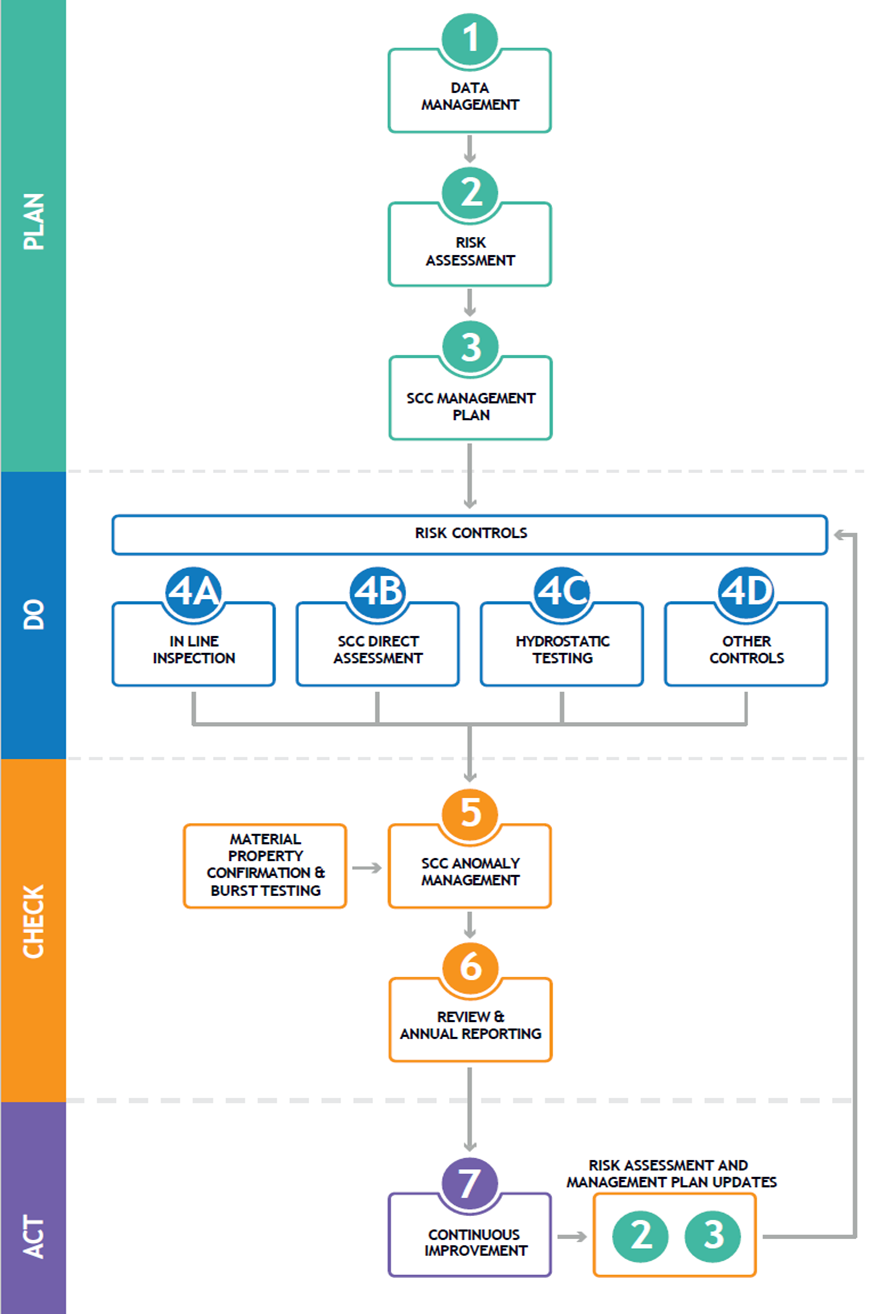
To support implementation, a complementary assessment tool, i.e. Rapid SCC Scan, was developed. The use of this assessment tool is embedded into the assessment process as shown below:

- Step 1 - Data Collection
-
Each SCC type (NNpH or High pH) requires a slight variation to the input data to evaluate the threat. The input data required was determined based on industry literature.
SCCDA History Integration: The tool incorporates the results of historical SCC direct assessment (SCCDA). Negative field findings help to reduce the baseline threat score, while confirmed SCC locations highlight areas where additional actions may be required. - Step 2 - Rapid SCC Scan Assessment Tool
-
Given the size and complexity of the pipeline network, in addition to the potential variation in each pipeline, the tool enables rapid identification and prioritisation of pipelines and segments requiring further evaluation.
Key features include:
• Risk Matrix Integration: Utilising a risk matrix aligned with AS 2885.6
• Data Import & Alignment: Automatically aligns uploaded SCC threat related data across all pipelines.
• Automated Segmentation: Divides pipelines into segments based on changes to input parameters, grouping similar segments for consistent assessment.
• Flexible Assessment Options: Supports evaluation of NNpH, high pH SCC or a combined ‘worst-case’ scenario. Users can also customise input parameters for tailored assessments.
• Comparative Risk Ranking: Automatic comparative risk ranking of all pipelines and segments within individual pipelines. - Step 3 – Define Action Plan
-
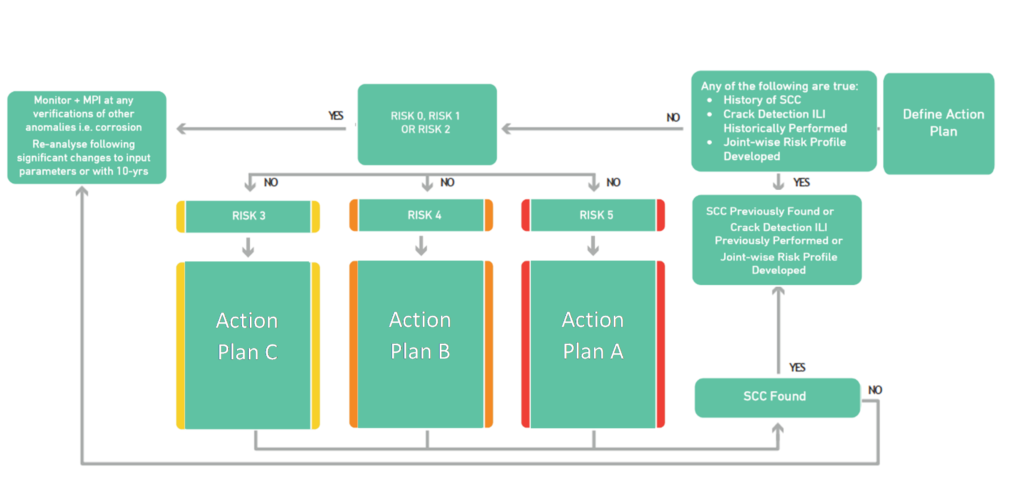
A streamlined decision-making process, aligned with AS2885.6 was developed to define appropriate actions for each pipeline segment. A flowchart guides users in determining the required response based on the results of the risk screening assessment.
The flow chart below guides the user to define certain actions per each unique pipe segment along a given pipeline.
Results
The framework enables the operator to evaluate the risk of axial SCC risk across its entire network, supporting efficient prioritisation, planning and assessment.
By integrating the ‘Rapid Scan SCC’ tool, assessment results can be continuously updated, enabling SCC management plans to be refined based on latest field findings. This approach facilitates ongoing alignment with industry standards and supports focussed, effective resource management.