Client: Iron Ore Slurry Pipeline Operator
Project:
Complex Fatigue Crack Growth Analysis
Overview
To support the ongoing management of fatigue cracking in a major iron ore slurry transmission pipeline, Frontline Integrity were asked to assist with the analysis of seam weld fatigue cracks identified as part of a targeted external Ultrasonic Time of Flight Diffraction (TOFD) inspection campaign. The pipeline had historically been subject to crack detection ILI however tool performance limitations associated with this specific location meant that additional risk control measures were required.
The primary objective was to evaluate the immediate operational integrity of the pipeline, with a further focus on calculating remaining life based on a number of potential future operating scenarios. Most importantly, the results of the analysis would determine whether immediate repair was required or whether remediation could be scheduled to coincide with future planned maintenance shutdowns.
Location
South America
Challenges Faced by the Customer
A number of complexities were associated with the analysis of the cracks, requiring a bespoke analysis methodology to be developed:
- Geometrical out-of-roundness (roof-topping) at the seam welds accelerating fatigue crack growth rates.
- Transient slurry/water batch operational regime depending on day-to-day feedstock processing rates from the mine. Resultant pressure cycling resulted in highly variable crack-driving forces.
- Aggressive high pH slurry corrosion-fatigue crack-growth relationship not quantified in industry standards.
- Measurement uncertainties surrounding the pipe joint out-of-roundness measurements and TOFD tolerances.
The Approach
The assessment process was divided into four phases:
- Fracture assessment (API 579 Part 9 Level 2)
This assessment was completed on the “as reported” crack dimensions. Additional stress concentration, due to out of roundness at the weld, was incorporated to confirm there was no short-term integrity threat requiring immediate intervention. Fracture toughness values were taken directly from testing on pipe spools from the same manufacturer and processing route to avoid unnecessary conservatisms being introduced.
- Rationalisation of operational data for crack growth analysis
Minute by minute pressure cycling data was supplied for a three-year period at the crack locations which represented a significant quantity of data. This was subsequently simplified using the Rainflow cycle counting method to define a stress histogram for each month and the determination of the “worst”, “best” and “likely” future pressure cycling regimes for crack growth.
- Benchmarking of crack growth rates from laboratory testing
Previous external inspection information for the same locations was available from three years prior to the recent inspection (2020 vs 2023). It was therefore possible to compare the predicted crack size to those observed in-field using laboratory derived crack growth parameters . This was critical to ensure sufficient conservatism in any remaining life predictions considering the lack of recognised industry data surrounding corrosion-fatigue crack growth in analogous environments.
- Remaining life assessment
The fatigue cracks reported in 2023 were subsequently analysed to determine their predicted remaining life based on the “best”, “worst” and “likely” pressure cycling regimes.
A significant uncertainty in the assessments was the sizing of the out-of roundness (i.e. roof topping) which had been undertaken using manual gauges. The roof topping must be accounted for in fatigue crack growth calculations as it amplifies the stress range seen by the crack and accelerates crack growth.
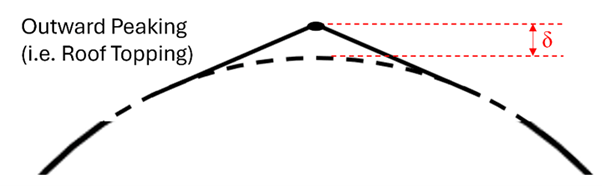
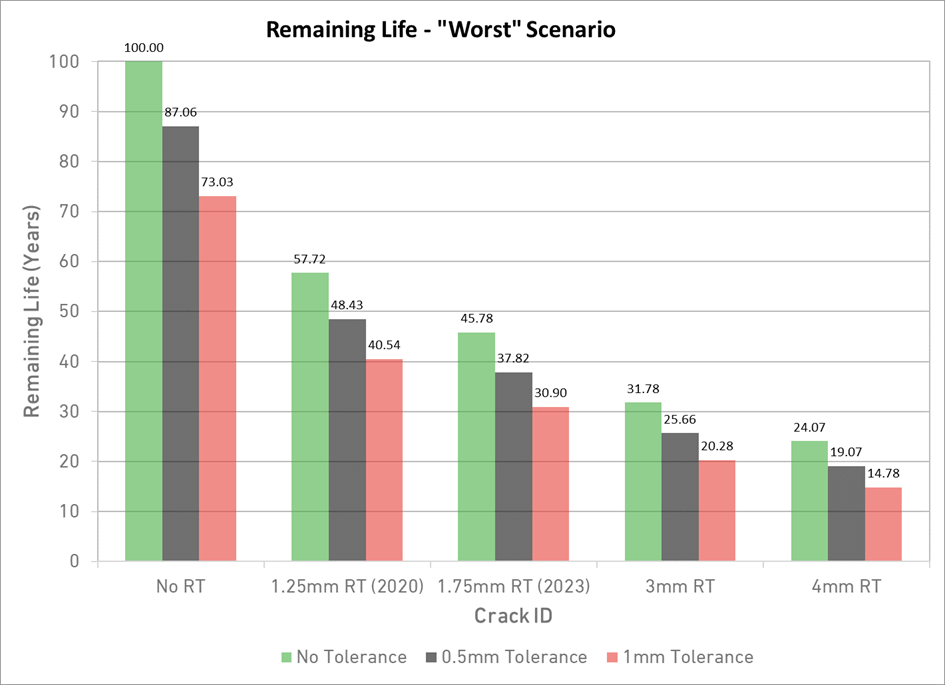
To account for the uncertainty in the sizing, a sensitivity analysis on remaining-life was performed to account for: no roof topping, the as-measured roof topping measurements and the maximum measured roof-topping values. This ensured sufficient conservatism in the assessment. An overview of the impact on remaining life when varying the level of roof topping is shown in the image below:
Results
The work provided:
- Confidence that these cracks would not pose an integrity concern in the short-term even when considering the “worst” case pressure cycling regime and roof topping measurement.
- Confidence to further monitor these cracks over a longer period of time to calibrate assessment methodologies and increase the reliability of any future integrity assessments elsewhere in the line.
- Confidence that the pipeline-specific crack-growth parameters derived through laboratory testing were suitably conservative.
- A complex but efficient procedure for the re-assessment of any cracks identified in these locations.