Client: Gas Pipeline Operator
Project:
Development of a Framework to Manage SCC
Overview
Frontline Integrity was engaged by a gas transmission pipeline operator in South America to enhance their integrity management program through the production of a framework to manage the threat of stress corrosion cracking (SCC) along the transmission network, considering both High pH and Near Neutral pH, axial and circumferential cracks.
Location
South America
Challenges Faced by the Customer
- Network Size and Characteristics: With a complex system of over 60 pipeline sections spanning more than 4,000 km across four regions, the operator required an approach that was both consistent and broadly applicable across the entire network.
- Uncertainty on Threat Level: SCC has been confirmed on some pipeline sections, with others identified as possibly being susceptible to SCC. However, gaining a clearer understanding of the threat level from a risk management perspective was essential to support the operator’s decision-making process.
- Data Availability: With limited data available, the operator needed to maximise the value extracted from existing sources in order to effectively prioritise areas for investigation and repair.
The Approach
The approach implemented a risk-based integrity management planning and response cycle, in which the controls applied to manage SCC (e.g. ILI or SCC Direct Assessment (SCCDA)) are directly proportional to the magnitude of risk present for a given pipeline. The cycle is executed annually to ensure that changes in risk may be appropriately identified and addressed.
This methodology presents several key advantages:
- Reduces unnecessary expenditure: Facilitates targeted allocation of resources by focusing efforts where they are most needed.
- Enables direct comparison: SCC risk levels can be directly compared across different pipelines, supporting informed budgeting and investment decisions.
- Demonstrates Corporate and Social Responsibility: Reflects a continuous commitment to reducing risk and support safe operations.
- Improved Sustainability: Aligns risk management practices with long-term operational goals.
- Ensures Compliance: Supports alignment with industry standards and regulatory requirements.
Procedure Development
The SCC management procedure was developed based on seven key steps, illustrated below:
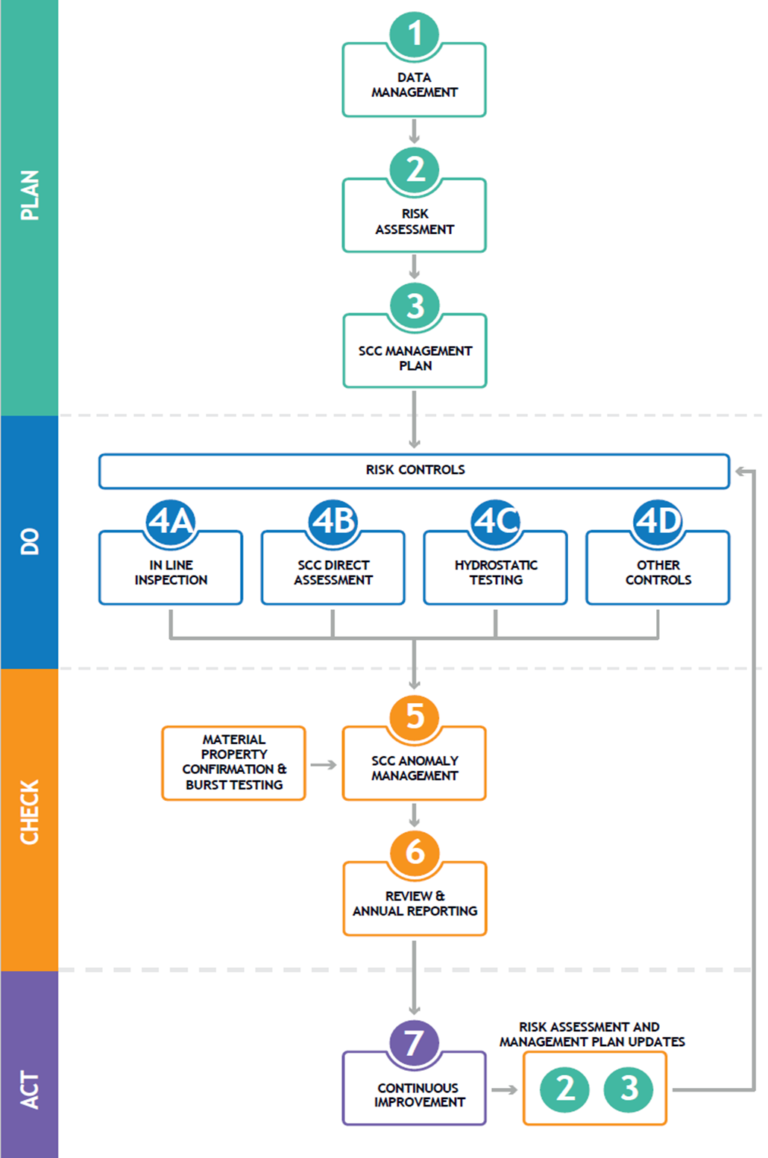
- An overview of each step is presented below:
- PLAN
-
Step 1: Data Management: Effective SCC management begins with collecting and integrating data from multiple sources, e.g. design, construction, operations, inspections, and maintenance. This supports ongoing evaluation of SCC threats across the pipeline network.
Step 2: Risk Assessment: Risk assessment evaluates both the likelihood and potential consequences of SCC-related failures. This step is central to identifying high-risk areas and guiding the prioritisation of integrity assessments and mitigation efforts.
Step 3: SCC Management Plan: Based on risk results, targeted risk control measures are selected using the ALARP (As Low As Reasonably Practicable) principle, ensuring effective mitigation relative to cost and risk reduction. - DO
-
Step 4: Risk Controls
- In-Line Inspection (ILI): Detects and characterizes anomalies like cracks, metal loss, or deformation. Effectiveness depends on pipeline condition and matching inspection objectives.
- SCC Direct Assessment (SCCDA): Evaluates SCC susceptibility and presence through pre-assessment, indirect inspection, direct examination, and post-assessment steps (per NACE SP0204).
- Hydrotesting: Verifies a pipeline’s ability to contain pressure, useful for determining MAOP but not for assessing remaining life.
- Additional Controls:
* Pressure Reduction – Lowers both failure probability and potential consequences.
* Recoating – Mitigates SCC by restoring protective coating and preventing water ingress.
* Section Replacement – Removes SCC risk by replacing affected segments with new pipe.Ste: - CHECK
-
Step 5: Anomaly Management: Confirmed or suspected SCC anomalies must be assessed, with appropriate mitigation actions such as pressure reduction or repair implemented as needed.
Step 6: Review & Annual Reporting: SCC-related activities are reviewed annually to ensure alignment with the Integrity Management Plan. Reporting includes inspection summaries, risk updates, KPI analysis, and action tracking.: - ACT
-
Step 7: Continuous Improvement: Lessons learned and new data feed into updated risk assessments, restarting the cycle to continuously enhance SCC management effectiveness.
Results
The process developed enabled the operator to manage the SCC threat in a more structured and systematic manner, while also identifying opportunities for further improvement, e.g. risk assessment, anomaly management, and ILI validation. Additionally, the procedure helped streamline workflows and documentation by identifying redundancies and consolidating overlapping documents, thereby reducing the risk of information duplication.
The procedure also enhanced stakeholder engagement by clearly defining roles and responsibilities throughout the process. This was particularly valuable from the integrity department’s perspective, given the involvement of multiple parties in SCC management.
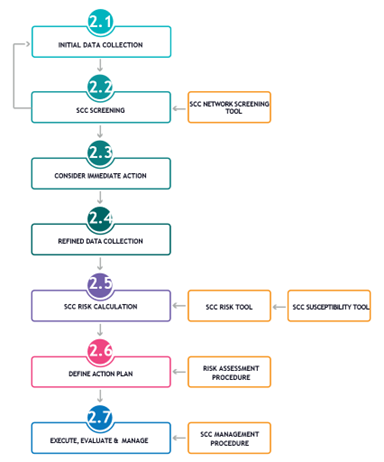
Some improvement areas were promptly addressed by the operator, most notably the SCC Risk Assessment, which plays a central role in the overall threat management process. A bespoke SCC risk assessment model was developed to evaluate the risk at the individual pipe joint level. This model adopts a semi-quantitative approach, with results categorised into five distinct risk levels. For instances where the risk is classified as “Not Tolerable” or “ALARP,” appropriate mitigation measures are recommended based on “What-if” and “Cost-Benefit” analyses. The figure below illustrates the developed SCC risk assessment process where the outcome is a set of risk controls designed to help the operator achieve ALARP in accordance the organisations risk management policy.