Case Study

Joint-by-Joint C-SCC Susceptibility Profile Development

Operator: Natural Gas Pipeline

Project: Joint-by-joint c-SCC Susceptibility Profile Development

Location

Asia Pacific

Overview

A pipeline operator recently identified a leak on one of their gas transmission pipelines. The mechanism was confirmed to be circumferentially oriented stress corrosion cracking (C-SCC). The discovery of this leak was quickly followed by the identification of further circumferentially orientated cracks at other locations on the same segment.

Given that there are limited in-line inspection technology options to reliably detect or size C-SCC in gas pipelines, the pipeline operator contracted Frontline Integrity to develop a susceptibility-led approach to further evaluate the severity of the circumferential threat along their pipeline to support their ongoing risk management.

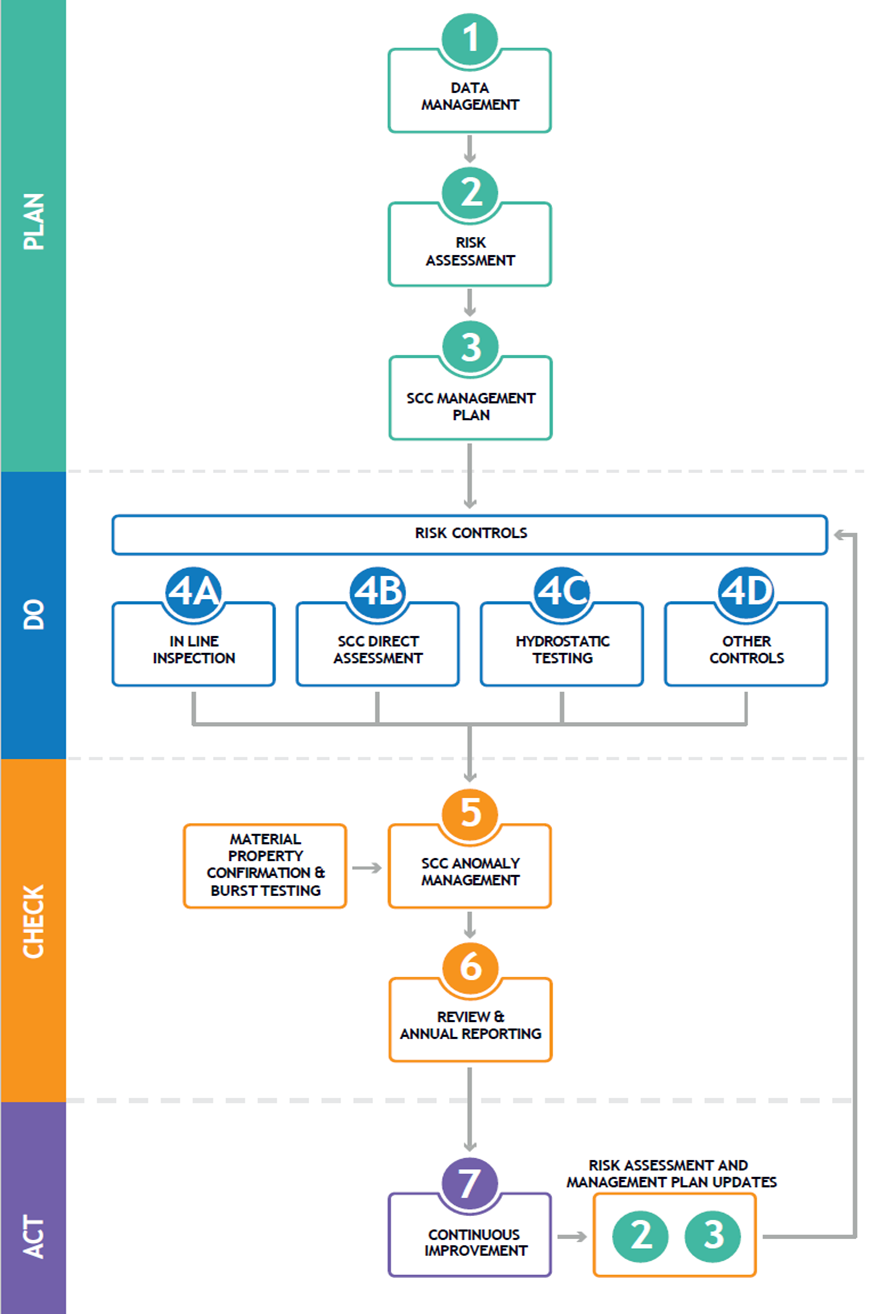
The overall susceptibility process defined and followed by Frontline Integrity is shown below. This process aims to implement a continuous improvement process whereby a susceptibility model is generated and calibrated over time as verifications provide more reliable information about the target threat.

The model was developed within our cloud-based software platform Rapid Susceptibility™.

The Approach

The approach to the development of an accurate susceptibility model was divided into three phases as shown below:

This case study focuses on the initial phase of work and involved the following steps:

Step 1 – The collection and alignment of large data sets considered to be relevant to understanding the threat of C-SCC. This involved challenging the alignment of data from multiple sources in many formats and with various granularity.

Step 2 – Following the alignment of all data sets, Frontline Integrity’s in-house susceptibility modelling software, Rapid Susceptibility™, could be used to develop an initial joint-wise susceptibility profile.

Step 3 – Once the initial model was generated, a review of verification sites both where C-SCC has historically been verified, and also where it has not, was performed. The review aimed to identify common patterns or trends that could be used to calibrate the susceptibility model. Frontline Integrity’s in-house susceptibility modelling software, Rapid Susceptibility ™, was once again used to review site-specific parameters.

Step 4 – Once patterns from the verification sites were identified, the model could be calibrated accordingly. The calibrated susceptibility profile was then used to recommend sites for verification. These sites were selected considering the following criteria:

  1. Current baseline model susceptibility score.
  2. Review of threat drivers and cracking contribution.
  3. Input data calibration considering some observed inconsistencies.

Next steps

From the initial calibrated model, a number of sites were recommended for verification. The next steps involve:

  1. Reviewing verification findings
  2. Further calibrating the susceptibility model
  3. Identifying sites for verification using this more accurate model.

Benefits

  • Identification of areas where cracking is likely to be most credible.
  • The new model allows the operator to develop a suitable management plan for the threat of circumferential risk along a gas transmission pipeline through direct assessment.
  • The model is updated and re-calibrated routinely with new field data.
  • The model can be extended to cover multiple cracking threats supporting further efficiencies in management via direct assessment.
  • Relatively low cost.