Onshore Liquid Pipeline Operator
Project:
Crack Fatigue Study
Location
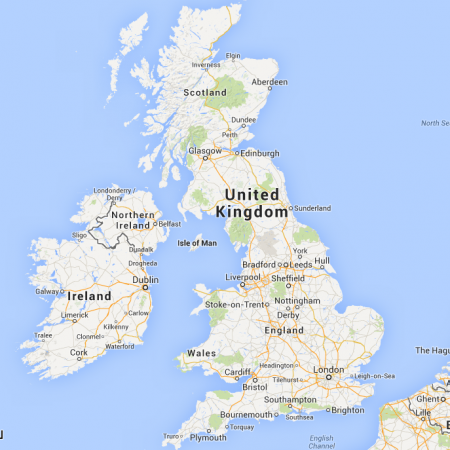
UK
Overview
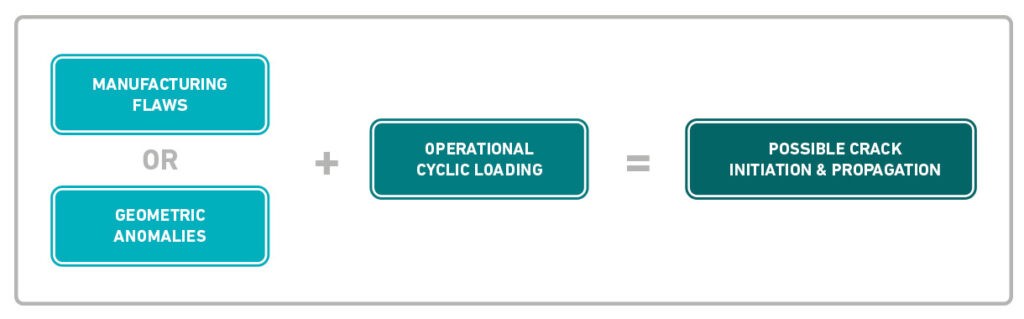
Liquid pipelines, particularly those operating in batch mode, are subject to significant pressure fluctuations and fatigue damage is considered a credible threat. Seam welds containing manufacturing flaws or areas of geometric damage (i.e. dents) are locations where cracks are considered most likely to initiate and propagate under operational cyclic loading.
Frontline Integrity were requested to evaluate the threat of fatigue cracking along a ~200km onshore liquid pipeline to feed into the operator’s integrity management strategy. The operation of this pipeline has not been consistent, and a lot of information was provided to understand the complete operational history and planned future regime. This work directly supported the ILI selection, particularly whether to include an ultrasonic crack detection tool in the upcoming campaign.
The approach
To fully appraise the threat of fatigue cracking the following approach was adopted:
- Benchmarking of pressure cycling aggressiveness – This considered the data associated with the entire life cycle of the pipeline and along the entire route.
- Review of manufacture and material testing records. This included a review of the longitudinal seam weld inspection criteria to identify credible starting flaw sizes.
- Review of any ILI reported defects that that could be susceptible to fatigue crack growth.
- Review of field verification records.
- Seam weld fatigue life screening using a 2-stage approach:
- Fatigue S-N approach which covers the nucleation (formation) and propagation (growth) of a crack to failure.
- Fracture mechanics engineering crack assessment (ECA) which assumed a starting crack size at commission and grows the crack through to failure, skipping the nucleation phase from the S-N assessment.
- Girth weld fatigue life screening – A fracture mechanics ECA was also conservatively performed for a circumferential girth weld crack in a similar manor to the seam weal fatigue screening.
- Dent fatigue life screening – The EPRG dent fatigue screening approach was adopted.
The Results
The project allowed the operator to:
- Understand the threat of fatigue cracking along their system.
- Assess the agressivness of the cyclic regime along the system and how this has changed over time considering the significant changes in operation.
- Quantify accumulated fatigue damage and remaining fatigue life along the system.
- Evaluate the benefit of running an ultrasonic (UT) crack detection tool.
The work concluded that the threat of a fatigue cracking was low in areas where UT crack detection capaibilities are not likely to be compromised. This enabled the operator to develop an appropriate and cost-effective management strategy.