Operator – Offshore Field
Project:
Technical audit of Offshore Pipeline Integrity Management System (PIMS) implementation
Overview
A pipeline operator required an expedited technical audit of their Pipeline Integrity Management System (PIMS) in response to a number of recent operational incidents. The system comprised approximately 150 offshore multiphase production, gas-lift and water injection lines with many of the lines dating back to the 1970s and 1980s and posing a variety of challenges associated with the integrity management of ageing assets. The audit leveraged the causal elements of the incidents and focused around the day to day implementation of the risk-management process; specifically risk assessment, risk-based planning and anomaly management.
Frontline Integrity conducted the audit within two months, using their in-house PIMS review methodology and experienced pipeline engineers comprising both consultancy and operational expertise. The PIMS was benchmarked against current best practice and, where required, improvements identified to reduce the likelihood of future operational incidents.
Location
Middle East

Background
Due to the transfer of assets between organisations around 35 years into the life of the fields, the available pipeline design, construction and historical integrity management information was very limited. To address this, the current operator had effectively implemented a completely new risk-based PIMS which resulted in a significant increase in the volume of integrity data collected in a very short period of time and therefore on the demands on the relatively small pipelines team.
The approach
The client requested that the PIMS audit focused on a number of recent operational events and that the entire project was completed within six weeks. The primary objective was to evaluate whether any improvements could be made to the current PIMS to prevent any future operational incidents. To meet the above, our Level 2 approach was adopted, i.e. our ‘Focused Implementation’.

The tight timescales required the auditors to have an extensive knowledge base across all PIMS areas. To facilitate this, Frontline deployed a team of Principal Engineers who each had over 20 years of practical experience in pipeline operations, risk management, inspection, defect assessment and failure investigation. . The following approach was adopted:
- Key PIMS documents were requested and reviewed (the ‘what is meant to be done’).
- A site visit was conducted where discussions were held with the key PIMS stakeholders based on the initial document review and the timeline of events/decision-making surrounding the offshore incidents. This included relevant contractors, vendors and the software systems used to support the implementation of the PIMS (the ‘what is actually being done’).
- A bench marking of the PIMS against current industry best practice was conducted with and opportunities for improvement were identified. This allowed the customer to focus on key areas for improvement. An example of the bench marking output is shown below.

Figure 1. A generic example of Frontline Integrity’s PIMS benchmarking scoring system
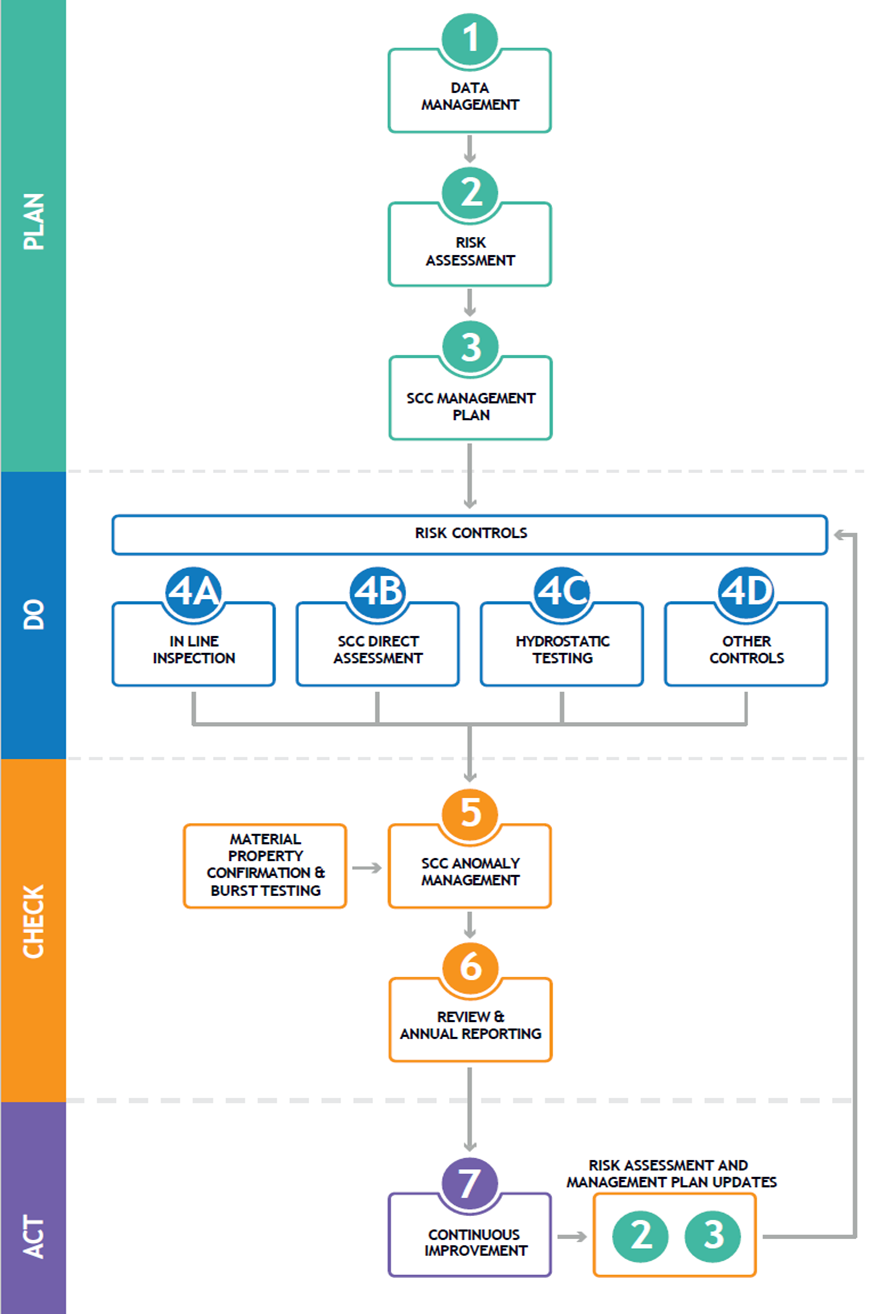
Frontline Integrity’s in-house development auditing and review method is based on international standards and practical experience within strict regulatory frameworks such as the UKCS (North Sea). The PIMS was assessed against the risk-based integrity cycle throughout the operating life of the assets; commonly known as Plan, Do, Check, Act. The PIMS was also reviewed with respect to twelve core ‘management control’ elements ranging from Management of Change to Abandonment.

Results
The development of the operator’s PIMS had started from a unique ‘standing start’ position well into the life of the assets and was still evolving as more information became available. Given the context, Frontline focused on identifying practical technical improvements to inspection, monitoring and surveillance activities, as well as the RBI methodology itself. This would improve differentiation between pipelines from a risk-assessment perspective and ensure those pipelines with higher risk were given enhanced focus from a risk-control perspective. Given the obvious commitment of management and key PIMS stakeholders to pipeline integrity management during the audit, achieving best practice for all core PIMS elements was envisaged to be achievable by implementing the action plan proposed by Frontline Integrity.